From 13–0 to Fired: Where Mike Norvell’s Florida State Rebuild Went Wrong
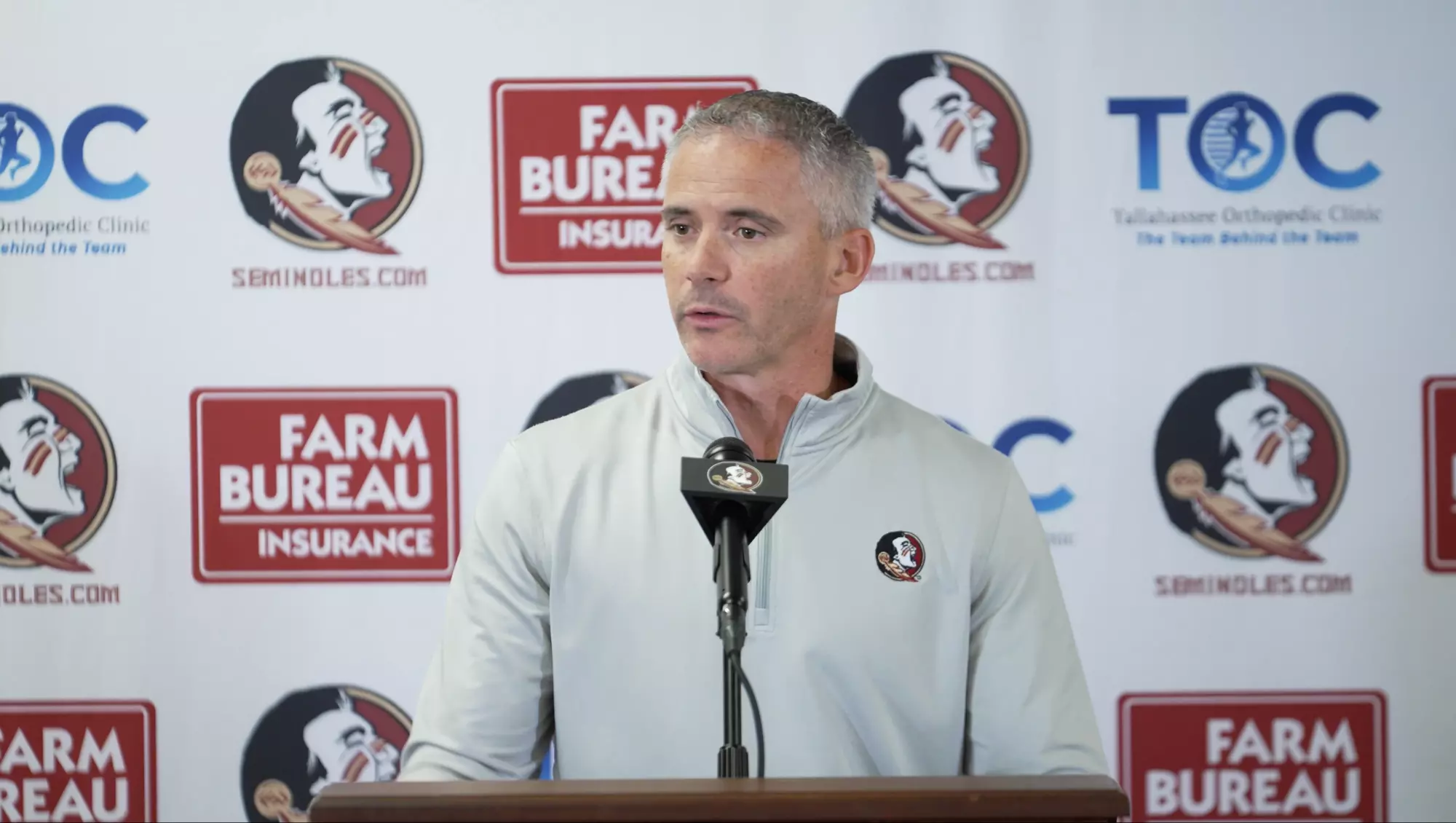
Mike Norvell brought Florida State back to a place its fans had spent years waiting to see. The Seminoles were winning rivalry games, producing NFL talent and celebrating an ACC championship.
Then, almost as quickly as the program returned, it fell apart.
Florida State fired Norvell on November 1, one day after a 36–24 loss to Clemson dropped the Seminoles to 3–5. He finished his tenure with a 41–39 record, less than three years removed from taking FSU through the regular season and ACC championship game undefeated.
The decline followed a series of decisions that failed to replace what Florida State lost after 2023. Transfer additions fell short of the roles they were brought in to fill. The quarterback position became an annual offseason project. A staff overhaul improved some numbers but never produced a lasting recovery.
By the time Norvell coached his final game, Florida State had spent nearly three seasons trying to fix problems it once appeared to have solved.
The Portal Built the Foundation
Norvell’s early transfer evaluations were a major reason Florida State became competitive again.
Jared Verse came from Albany, Johnny Wilson arrived from Arizona State and Tatum Bethune transferred from UCF. Trey Benson joined from Oregon. Those additions helped FSU build toward its championship season rather than asking one incoming class to repair the entire roster.
Verse became a disruptive presence off the edge. Wilson gave the passing game a difficult matchup, while Benson brought explosiveness to the backfield. They joined a program that was beginning to receive more dependable play from the players already on campus.
Florida State then added Keon Coleman from Michigan State, Jaheim Bell from South Carolina and Braden Fiske from Western Michigan. Coleman had already produced an impressive season in the Big Ten, and Fiske arrived with 30 college starts.
The staff found players who could help immediately and put them alongside an experienced quarterback. Jordan Travis threw 20 touchdown passes against two interceptions in 2023 and added seven rushing touchdowns before his season-ending injury.
Travis’ development was as important as any transfer signing. He knew the offense, limited mistakes and could rescue a play when protection broke down. The players around him gave Florida State enough ways to win that an uneven quarter did not have to become a loss.
That team’s talent was evident the following spring. Ten Seminoles were selected in the 2024 NFL Draft, including six among the first 100 picks.
Replacing that group was always going to be difficult. Florida State’s mistake was underestimating how much had to be replaced—and how few proven answers it had behind them.
2024: The Replacements Were Not Ready
DJ Uiagalelei became the biggest name attached to the 2024 collapse.
Florida State brought him in to provide experience after Travis, but the offense never settled around him. In five appearances, Uiagalelei completed approximately 53.8% of his passes for 1,065 yards, four touchdowns and six interceptions. An injury ended his season, but the problems were apparent before that.
Uiagalelei did not have Travis’ ability to cover up mistakes, and the supporting cast was less equipped to help him. The running game struggled, protection was unreliable and the receivers did not consistently replace the production that had left.
Malik Benson, an Alabama transfer, finished with 25 catches for 311 yards and one touchdown. Florida State needed a dependable receiving threat after losing Coleman and Wilson. Benson had productive moments, but they did not become a productive season.
Marvin Jones Jr. was another addition built largely around what the staff believed he could become. The Georgia transfer had a five-star recruiting background and a strong family connection to FSU, but he arrived with one college start and two sacks across two seasons.
There was reason to pursue his potential. There was also a risk in depending on that potential to help replace a player such as Verse.
Too many positions carried similar uncertainty. Florida State needed immediate production from a group that still had substantial questions to answer.
The final offensive numbers showed how badly the plan failed. FSU averaged approximately 15.4 points and 270.2 yards per game, including just 89.9 rushing yards. The Seminoles gained 2.9 yards per carry.
The problems went beyond the transfer class. A stronger group of returning players might have absorbed some of those misses. Instead, Florida State lacked enough dependable depth to keep the season from becoming 2–10.
2025: Improvement Came With the Same Search for Answers
Norvell responded by changing his staff and again turning to the portal.
Tommy Castellanos arrived from Boston College with a previous connection to new offensive coordinator Gus Malzahn, having played for him at UCF. His running ability gave Florida State something it had badly lacked the previous season.
Castellanos threw for 2,760 yards with 15 touchdowns and nine interceptions in 2025. He also led the Seminoles with 557 rushing yards and scored nine rushing touchdowns. His completion rate, however, finished at approximately 58.3%.
He contributed too much to be dismissed as a complete portal failure. But Florida State had again entered a season depending on an incoming quarterback to stabilize its offense, and the results remained inconsistent.
Squirrel White was a clearer disappointment in terms of production. He came from Tennessee with 131 career catches for 1,665 yards. In 10 games at FSU, he caught five passes for 52 yards.
A player’s previous résumé could justify the signing. It could not guarantee that Florida State would receive the same production. Evaluating the fit and finding a useful role remained the staff’s responsibility.
There were improvements elsewhere. FSU’s offense averaged 472.1 yards and 33 points per game, with its rushing average climbing to 218.7 yards. The team was considerably more capable offensively than it had been in 2024.
The wins did not follow consistently enough. Florida State beat Alabama to open the season and reached 3–0, then lost four straight against Virginia, Miami, Pitt and Stanford. The Seminoles finished 5–7.
The recovery had produced better football in stretches. It had not produced a team that could be trusted from week to week.
The Staff Changes Did Not Save Norvell
The hires of Malzahn and Tony White were supposed to address the failures that had become impossible to ignore in 2024.
Malzahn brought experience and a longstanding relationship with Norvell. Herb Hand and Tim Harris Jr. also arrived from UCF, giving the offensive staff familiarity as it installed its system.
There was a reasonable case for the hire, and the offensive improvement deserves credit. But Florida State needed more than a rebound in season averages. It needed an offense that could consistently help win conference games.
The Alabama victory suggested that was possible. Scoring 13 points in a loss at Stanford showed how far the offense still had to go. Malzahn’s retirement in February 2026 then left FSU making another transition, with Harris promoted to coordinator.
Norvell could not necessarily have anticipated that retirement. Still, the arrangement lasted one season and failed to provide the long-term stability his program needed.
White’s hiring also came with a strong résumé. He had coordinated four consecutive top-25 defenses at Syracuse and Nebraska before coming to Tallahassee. His first FSU defense improved across major categories in 2025.
The concern was how quickly that progress disappeared.
By his dismissal in 2026, Florida State ranked 111th nationally in rushing yards allowed per game and 114th in passing yards allowed per game, according to WCTV.
White had shown his defense could work elsewhere and could improve FSU initially. But he and the staff did not maintain that improvement through personnel changes and another season of opponents adjusting.
Both coordinator hires had reasons behind them. Neither ultimately delivered the sustained results required to keep Norvell in his job.
2026: Another Quarterback, Another Uneven Season
Ashton Daniels became the next veteran quarterback brought in to help settle the offense. He arrived with 23 career starts from his time at Stanford and Auburn.
His performance against Virginia showed what the staff saw in him. Daniels rushed for 136 yards and a school-record five touchdowns while adding 183 passing yards in a 38–7 victory.
Against Clemson, he threw for 350 yards and two touchdowns—but also three interceptions.
Daniels was capable of creating big plays. Florida State still could not consistently turn that production into efficient, winning football.
Uiagalelei, Castellanos and Daniels were different quarterbacks playing under different circumstances. Their consecutive arrivals nevertheless reflected the same unresolved issue: Florida State kept needing an immediate answer at the position after Travis.
The portal offered experience. It never restored the continuity the Seminoles had lost.
The Decline Became Too Much to Overlook
The playoff exclusion after the 2023 ACC championship remains a painful part of this story. Florida State kept winning after Travis’ injury and still was denied the chance to compete for a national title.
But that decision cannot explain every evaluation, coaching choice and performance that followed. Norvell remained responsible for preparing the next team.
The final Clemson loss left Florida State 3–5 overall and 1–4 in the ACC. With the Seminoles still within reach late, Clemson quarterback Tait Reynolds broke a 79-yard touchdown run with 3:17 remaining, pushing the lead back to 12 points.
It was one more game in which FSU had an opportunity and could not finish the job.
Norvell’s early success was real. His staff identified overlooked talent, developed players and assembled a championship roster. After that group departed, too many evaluations missed, too few replacements were ready and too many attempted fixes required another offseason to work.
By November 2026, Florida State was no longer willing to wait for the next one.